Please take a look at www.atlaslab.net and www.010collaborative.blogspot.com to see the latest!
Tuesday, July 24, 2012

Saturday, December 10, 2011

Wednesday, December 7, 2011

Wednesday, June 15, 2011
a new staging ground competition: thailand
This past winter, a competition was held to envision a playground for a small school in Thailand. the brief requested that tires be a primary construction component. Staging Ground proposed a playful adaptation of "chutes and ladders".


The importance of usable open space has been well documented at various times and at various places throughout the world. For centuries small parks and playgrounds have functioned as vital social networking tools and places of reprieve from the city and home. When networked, these parks have the capability to provide and enhance transferences of the social ethos, strengthening bonds and establishing new ones. These peer-to-peer relationships, while often ignored, are a necessity to communities of any scale and location. Research has shown small open spaces to not only provide the infrastructural benefits, but also health benefits of lowering blood pressure, decreasing fear and anger and contributing to the education of children.
Given these benefits, this project develops a proposal for the Baan Tha Aj in Mae Sot School that is highly adaptable in terms of play and use, while establishing a new productive piece of infrastructure. The focal point of the design hinges around a specific typology of the playground that builds off of Aldo Van Eyck’s work in postwar Amsterdam. Van Eyck used the playground as a community node, recognizing its value, particularly in times of stress. Facilitating cross-generational interactions through multilayered programs allows for a more comprehensive daily use, engendering a social investment and care for this space. In the case of the Baan Tha Aj School these programs focus on active play, formal educational activities, gardening and shaded passive spaces.
The application of surfaces and elements into site, give the program physical form should be inventive and in some ways repetitive. Repeated elements take the base form of a raised tire, built from a stilt-work of bamboo poles. This element is repeated throughout the design and is manifested in 5 forms, varying in size and use. The simple structure may be used as a node of gardening and landscape or as a simple play structure, easily constructed and durable.
The surface is developed to both add interest, permitting a higher degree of creative play, and to create a sense of enclosure from the exterior of the site. Constructed with rammed earth technology, tires are integral to creating a stable and inexpensive retaining wall and elevation change. The displaced soil from the structure’s footing is used as fill to establish the amphitheater styles chutes. Through the overlay of the surfaces and elements a dynamic and adaptive play space is established, fostering spontaneous and creative play activities while allowing for an infusion of landscape and gardens.
Play spaces are not an extra item that can be ignored. As a part of the urban infrastructure, they are as essential as roads, bridges and utilities. As a part of the social fabric they are just as important as schools and hospitals, often providing similar functions.
Monday, May 30, 2011

Saturday, March 19, 2011

Saturday, February 19, 2011

Sunday, November 7, 2010

Wednesday, November 3, 2010


Thursday, September 23, 2010

In both the New York Times and CNN articles surfaced which pits China and Japan against eachother in a battle over the spattering of "islands" scattered throughout the area. Their attention to atolls, reefs and rocks, which have otherwise gone unnoticed sparks a fascinating discussion on the importance (for the fact that we are now reliant on them) of these small and sensitive landmasses.
The effort being expended in securing the political boundary of island groups like the Paracel's and Spratley's as well as their physical mass is impressive and soon occur on an industrial scale. What new forms of preservation will their future bring? Actions have ranged widely from the "ecological preserve" of the Dongsha Atoll to the titanium and concrete bunker of Okinotori-shima atoll. With the hope of protecting economic rights to a vast underground reserve of oil and natural gas, we may see the South China Sea emerging as new testing ground for the preservation of this second hand industrial ecology.
Sunday, September 19, 2010
ghost states

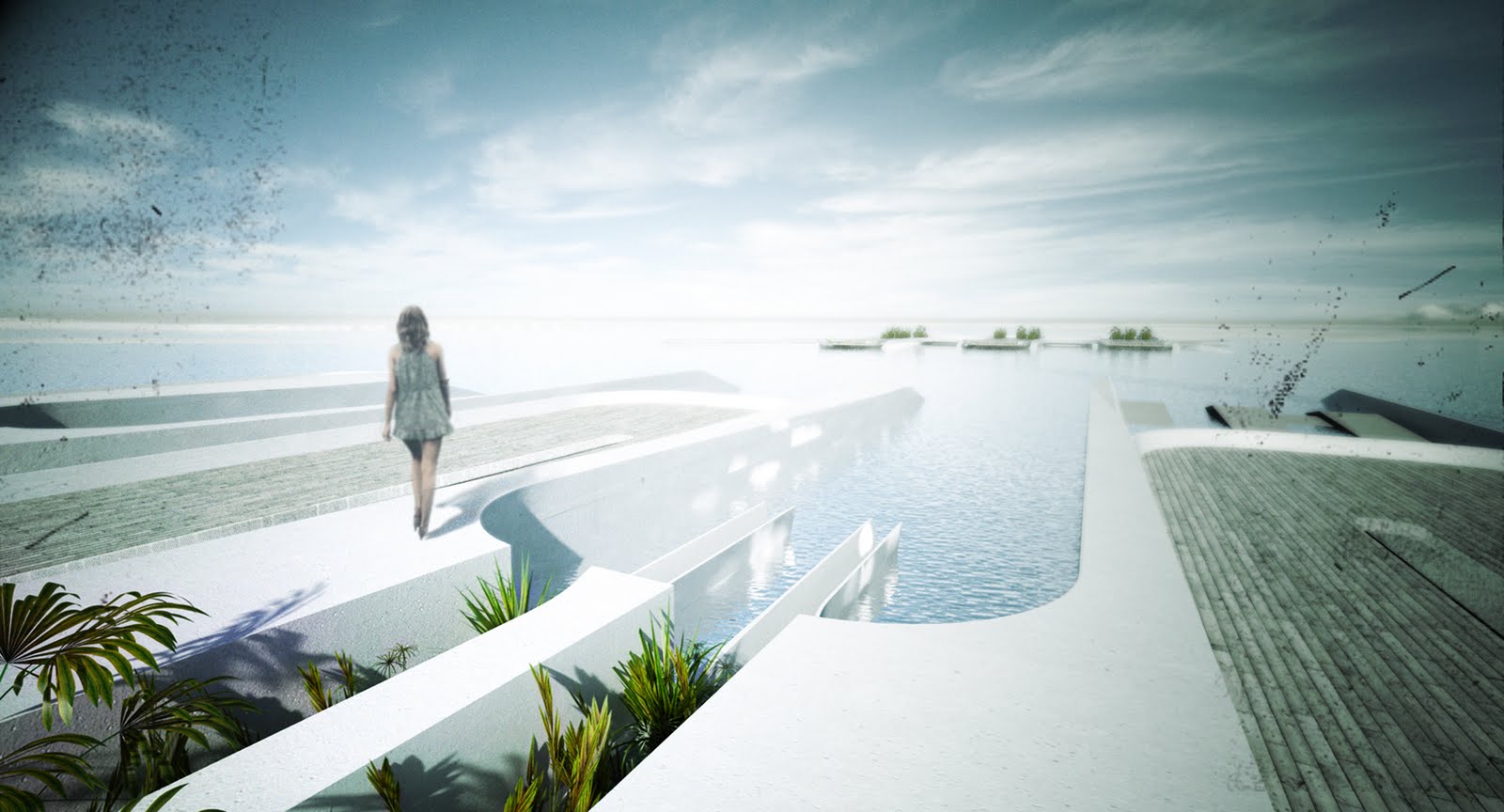
The South China Sea carries with it an increasingly critical array of islands and atolls whose seemingly insignificant landmass is emerging as a contentious player in the sino-global politic. Sea level rise and a growing environmental degradation of the region threaten an erasure of these small rocks and reefs. Their disappearance implies significant changes in economic zones and trade routes; for these reasons surrounding nation states have engaged in a massive military and political effort to secure these regions for their agency.
Structural fortifications have commenced to buffer against the growing threats of a rising sea level, taking forms ranging from titanium breakwaters and dams to tactical coral reef farms. The future of these projects will promise the fate of these new and possible ghost states. The advent of ecological infrastructure as a mode of practice provides a new and useful lens through which new possibilities might be hybridized securing the political and economic futures along with an ecological impetus.
Tuesday, August 10, 2010
staging ground continues
a small note to the small reading group: i will be continuing this blog as a venue for on-going research on the south china sea, its islands and atolls and the social/political/economic implications in lieu of global sea rise.
i hope to provide a full post shortly, in the mean time, the name of the project will be "territories of emerging ghost states" and will eventually expand from the the south china sea into broader issues with remote island, focusing on guano island and submerging atolls. until then...
i hope to provide a full post shortly, in the mean time, the name of the project will be "territories of emerging ghost states" and will eventually expand from the the south china sea into broader issues with remote island, focusing on guano island and submerging atolls. until then...
Tuesday, June 8, 2010


Subscribe to:
Posts (Atom)